As an Amazon Associate this site earns from qualifying purchases.
Quick Comparison Table
| Power Bank | Best For | Capacity | Max Watts | Price | Rating |
|---|---|---|---|---|---|
| charmast 20000mAh Portable Charger with Built in Cables | Longest carry-on runtime | 20,000mAh | 22.5W | 4.7/5 | |
| INIU 45W Fast Charging Portable Charger | Fastest charging, smallest | 10,000mAh | 45W | 4.5/5 | |
| Anker Portable Charger | Brand-name reliability | 10,000mAh | 30W | 4.5/5 | |
| Miady Portable Charger | Couples & two-device trips | 2x 20,000mAh | 22.5W | 4.5/5 | |
| Power Bank, 15000mAh Portable Charger with Built in Cable, 22.5W Fast | Charging several devices at once | 15,000mAh | 22.5W | 4.5/5 |
As an Amazon Associate, we earn from qualifying purchases.
Last Updated: July 2026 | Written by the JoltCell Editorial Team
The best power bank for travel in 2026 is the one that actually makes it through airport security in your carry-on and still has enough capacity to matter. That is a narrower list than it sounds. Every pack below sits comfortably under the FAA's 100 watt-hour ceiling, so none of them will get pulled at the gate — but they differ enormously in capacity, charging speed, built-in cables and whether you get one unit or two. This guide compares six specific portable chargers using their manufacturer-listed specifications and Amazon listing data, checked in July 2026.
When shopping for best power bank for travel, it pays to compare specs, capacity, and real-world runtime before committing.
A quick note on how we work: we do not physically test, own, or use these packs, and nobody here has systematically read the customer reviews. What follows is a close reading of the manufacturer's published specifications and Amazon's product data for each listing, turned into the trade-offs that actually decide which one belongs in your bag.
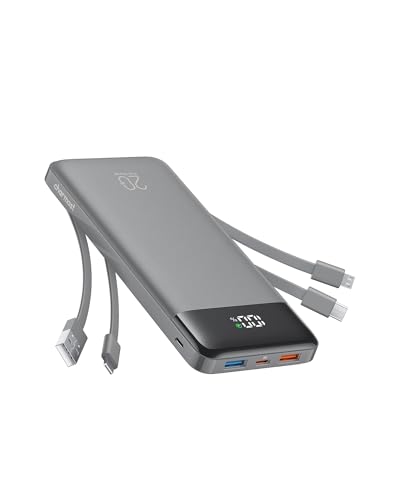
- Stay Powered Anywhere: This 20K portable charger delivers 3-4 full phone charges - ideal for camping, flights, or emergencies. Fits easily in backpacks to keep devices alive
- 3-in-1 Built-in Cables: No more hunting for cables! This power bank has USB-C and Micro-USB cables built in, compatible with iPhone and most devices — just plug in and charge. No
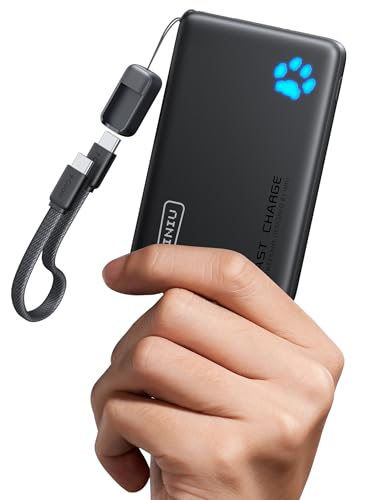
- 40% Smaller & Lighter Portable Charger: Powered by the industry’s first TinyCell high-density battery technology, this ultra-compact 10,000mAh portable charger power bank is 40%
- 45W Pro Speed Portable Phone Charger: This 45W fast charger boosts an iPhone 17 Pro Max to 76%, a Galaxy S25 Ultra to 84%, or an iPad Pro to 60% in just 30 minutes
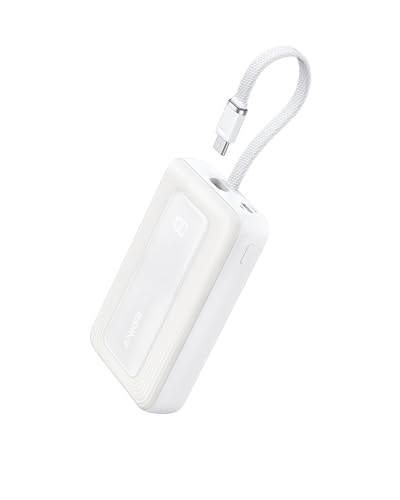
- Speedy 30W Charging: Experience cutting-edge 30W fast charging technology—twice as fast as 5V/3A chargers. Boost an iPhone 16 Pro Max to 50% in just 27 minutes, compared to an
- Ready for Endless Use: Crafted for durability, the 5.4-inch built-in USB-C cable is tested to endure over 10,000 bends, ensuring it stands up to the rigors of everyday use
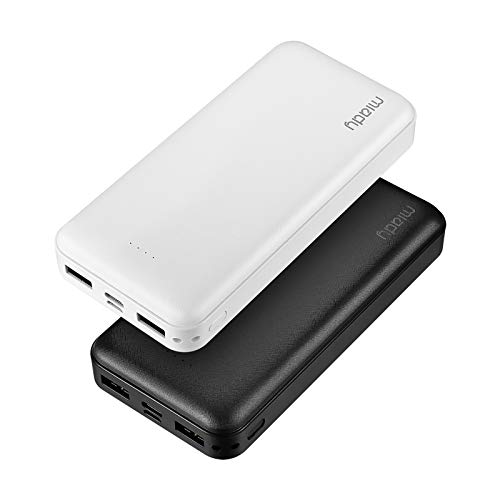
- Upgraded USB-C Fast Charging: Type-C port of Miady power bank output supports 22.5W max fast charging, which ensures your devices get juiced up quickly.And portable phone charger
- 20000mAh Powerful Capacity & Compact Size: Seamlessly fit Miady portable iphone charger for travel into your pockets or bags, thanks to its compact dimensions of 5.5*2.6*1 in
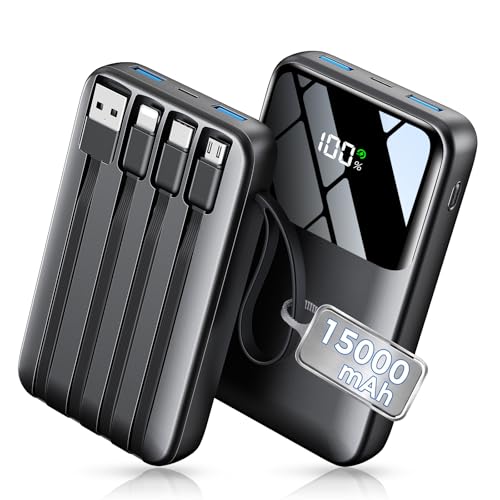
- Up to 3.5 Phone Charges On the Go: Compact and easy to carry, this 15,000mAh power bank keeps you powered for travel, commuting, and emergencies. Charges iPhone 17 up to 3.5
- 40% Smaller, 45% Lighter: Designed for power without the extra bulk, this compact power bank is 40% smaller and 45% lighter than conventional models, making it easy to carry for
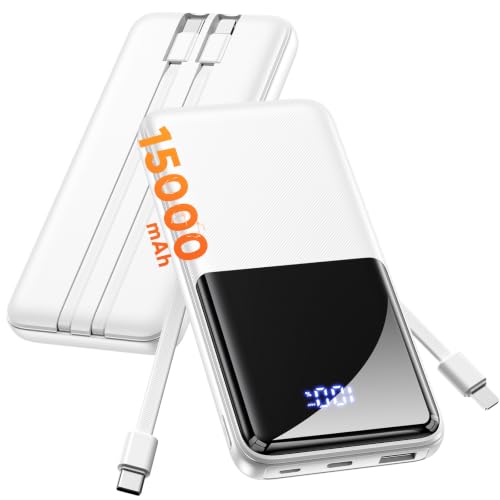
- Portable Charger with 2 Built-in Cables >>>: PB-08 battery pack has 1* iOS cable, 1* Type-C cable, 3* Charging ports(USB-A, Type-C, Micro), which supports charging almost all
- 15000mAh Mini Size, Lighter & Smaller Than a Phone >>>: Tired of hauling a brick-like power bank? The PB-08 uses high-density polymer battery technology to deliver 15,000mAh
The TSA and FAA Rule in One Paragraph
Here's the thing most "TSA-approved" listings gloss over: there is no TSA certification for power banks. The real rule comes from the FAA and it is about watt-hours, not brand marketing. Lithium-ion power banks must travel in your carry-on bag, never checked luggage, and any pack under 100 watt-hours (Wh) is allowed without airline approval. To convert the mAh number on the label to watt-hours, multiply by the cell voltage (3.7V nominal) and divide by 1,000. A 20,000mAh pack is roughly 74Wh; a 10,000mAh pack is roughly 37Wh. Every product in this roundup is a 10,000mAh, 15,000mAh or 20,000mAh unit, which means every one of them clears the 100Wh line with room to spare. That is the single most important fact for a traveler, and it is why these six made the list.
Quick Picks
- Most capacity in one legal carry-on unit: charmast 20000mAh Portable Charger with Built in Cables — roughly 74Wh, well under the 100Wh limit.
- Fastest and most packable: INIU 45W Fast Charging Portable Charger — 45W output in a 10,000mAh body the listing says is 40% smaller.
- The known-brand safe bet: Anker Portable Charger — the only established name here.
- Two packs, one purchase: Miady Portable Charger — one for you, one for a travel partner.
- Built-in cables, no dongle hunting: charmast 20000mAh Portable Charger with Built in Cables and the Power Bank, 15000mAh Portable Charger with Built in Cable, 22.5W Fast.
The Reviews Caveat You Should Read First
Honestly, we have to flag this up front: as of the July 2026 data check, all six listings show a star rating but zero written reviews. A 4.7 or 4.5 with no review count behind it is a thin signal — it could reflect a handful of early ratings rather than thousands of verified buyers. We are ranking these on their published specifications, not on a deep pool of buyer feedback, because that pool does not yet exist for these particular listings. Before you buy any of them, open the live Amazon page and check whether the review count has grown and what the 1-star reviews say. We would rather tell you that than pretend the ratings mean more than they do.
The Best TSA-Approved Travel Power Banks for 2026
charmast 20000mAh Portable Charger with Built in Cables — Best for Longest Carry-On Runtime
The charmast 20000mAh Portable Charger with Built in Cables is the capacity leader in this group as a single legal unit. At 20,000mAh it works out to roughly 74Wh — comfortably inside the 100Wh carry-on ceiling, so it will not need airline sign-off. For a traveler, that number translates to multiple full phone recharges from one pack, which is the whole point on a long-haul day when you cannot count on a seat outlet.
What sets this one apart on paper is the built-in cables. The listing title specifies integrated cables plus a USB-C port and 22.5W fast charging, which means you can leave the tangle of loose Lightning and USB-C cords at home. That is a genuine convenience for carry-on packing, where every cable you eliminate is one less thing to dig for at the gate. The title calls out compatibility with iPhone 17 through iPhone 12, iPad, Samsung and Android tablets, so the built-in connectors are meant to cover the common device spread.
The honest trade-off is speed. 22.5W is solid for phones but it is not the fastest here — the INIU's 45W will refill a modern phone noticeably quicker. And a 20,000mAh pack is the heaviest, bulkiest option in the roundup; that capacity has to live somewhere. It carries a 4.7/5 rating, the highest listed, but remember that comes with zero written reviews behind it.
Pros:
- Highest capacity here (20,000mAh, ~74Wh) yet still TSA/FAA carry-on legal
- Built-in cables reduce what you have to pack
- 22.5W fast charging and a USB-C port
- Broad stated compatibility from iPhone 17 back to iPhone 12, plus Samsung and tablets
- Highest listed rating in the group at 4.7/5
- Heaviest and bulkiest pick — capacity has a weight cost
- 22.5W is beaten by the 30W and 45W packs here
- 4.7/5 rating rests on zero written reviews
INIU 45W Fast Charging Portable Charger — Best for Fastest Charging in the Smallest Body
The INIU 45W Fast Charging Portable Charger is the speed-and-size play. Its listing headlines 45W output — the highest wattage in this roundup — inside a 10,000mAh pack the title describes as "40% smaller." For a traveler, that combination is the sweet spot: high enough wattage to fast-charge a modern phone, small enough to disappear into a jacket pocket, and at roughly 37Wh it is nowhere near the 100Wh limit.
INIU also leans into the travel angle directly, calling it a "Flight-Safe Travel Power Bank" with a detachable cable and a USB-C port. The detachable cable is the counterpoint to charmast's built-in approach — you can swap in the exact cable your device needs rather than being locked to what is molded in. The title lists iPhone 17 and 16 Pro, iPad, Samsung S26 and Google among supported devices.
The catch is capacity. 10,000mAh is half of what the charmast or Miady packs hold, so you get fewer total recharges before the bank itself is empty. If your travel day is long and outlets are scarce, this smaller cell will tap out sooner. The 45W ceiling is most useful for phones and lighter USB-C loads; it is not a laptop-class charger. Rated 4.5/5, again with no written reviews yet.
Pros:
- Highest wattage here at 45W — quickest phone top-ups
- Listed as 40% smaller, the most pocketable pick
- Detachable cable lets you match any device
- Explicitly marketed as flight-safe; ~37Wh is far under the limit
- 10,000mAh means the fewest total recharges of the larger packs
- 45W suits phones, not serious laptop charging
- 4.5/5 with zero written reviews
Anker Portable Charger, 10,000mAh 30W Power Bank — Best for Brand-Name Reliability
Look, the Anker Portable Charger is the only established brand name in this group, and for a lot of buyers that alone is the deciding factor. Anker has a long track record in the charging category, so if you are wary of the unbranded packs elsewhere on this list, this is the reassurance pick. It is a 10,000mAh unit — roughly 37Wh, deep inside carry-on limits — rated at 30W with USB-C in and out.
That "USB-C in and out" detail matters more than it sounds. It means the same USB-C port that charges your phone also recharges the bank itself, so you travel with one cable standard instead of hunting for a micro-USB cord to refill it. The 30W output slots between the 22.5W crowd and the INIU's 45W — quick enough for fast phone charging, and enough headroom for lighter USB-C devices. The listing names iPhone 17/16 and Galaxy among supported phones and specifies a white finish.
The trade-off is capacity versus the big packs: at 10,000mAh you get the same fewer-recharges limitation as the INIU, without the INIU's higher wattage or its "40% smaller" size claim. You are partly paying for the name. And despite the brand pedigree, this specific listing also shows a 4.5/5 with no written reviews yet, so verify the live page before buying.
Pros:
- The only established brand in this roundup
- 30W output with USB-C in and out — recharge the bank with the same cable
- 10,000mAh (~37Wh) is easily carry-on legal
- Names iPhone 17/16 and Galaxy compatibility
- 10,000mAh trails the 15,000 and 20,000mAh packs on total runtime
- 30W is beaten by the INIU's 45W
- 4.5/5 with zero written reviews despite the brand name
Miady Portable Charger, 2-Pack 20000mAh — Best for Couples and Two-Device Trips
The Miady Portable Charger answers a different question: what if two people are traveling, or you want a spare? This is the only 2-pack here — you get two separate 20,000mAh banks in one purchase. Each unit is roughly 74Wh, so each is independently carry-on legal. That is worth stressing for air travel: two packs of this size is fine, but the FAA generally limits you to a sensible number of spare batteries, so two is a practical, non-fussy quantity.
Spec-wise each pack lists PD 22.5W output, multiple USB output ports and Type-C fast in-and-out charging. The title names iPhone 16 through iPhone X, Galaxy 24/22, iPad and Android as supported. For a couple, the appeal is obvious — one bank each, no negotiating over whose phone charges first, and a combined 40,000mAh of reserve across the two units without either one breaking the per-unit limit.
The trade-offs mirror the charmast: 22.5W is mid-pack on speed, and two 20,000mAh bricks are the heaviest total payload here if you actually carry both. Unlike the charmast and the 6-output pack, these rely on your own cables rather than built-in ones. Rated 4.5/5, with no written reviews at the time of writing.
Pros:
- Two full 20,000mAh banks in one purchase
- Each unit (~74Wh) is independently carry-on legal
- PD 22.5W with multiple USB ports and Type-C in/out
- Ideal for two travelers or a primary-plus-spare setup
- Carrying both is the heaviest total load in this roundup
- No built-in cables — bring your own
- 22.5W trails the 30W and 45W options; 4.5/5 rests on zero reviews
Power Bank, 15000mAh Portable Charger with Built in Cable, 6 Outputs — Best for Charging Several Devices at Once
The Power Bank, 15000mAh Portable Charger with Built in Cable, 22.5W Fast is the multi-device specialist. Its headline feature is six outputs — the most connection points of any pack here — plus a built-in cable and an LED display. For a family or anyone juggling a phone, earbuds and a smartwatch on the same layover, six outputs means everything charges together instead of in shifts.
Capacity sits at 15,000mAh, roughly 55Wh, which splits the difference between the 10,000mAh compact packs and the 20,000mAh heavyweights while staying well under the carry-on limit. The listing lists 22.5W fast charging and describes a slim form factor, so you are not paying for the six outputs with a brick-sized body. The LED display is a practical travel touch — a precise percentage readout beats guessing from four dots when you are deciding whether to top up before a flight. The title names iPhone 17 through iPhone 13 and iPad compatibility, in a black finish.
The honest limits: 15,000mAh shared across six simultaneous outputs drains faster per device than feeding a single phone, and 22.5W is the total fast-charge ceiling rather than 22.5W to every port at once. This is convenience-first, not the fastest single-device charger. Rated 4.5/5, with no written reviews yet.
Pros:
- Six outputs — charge the most devices simultaneously here
- Built-in cable plus an LED percentage display
- 15,000mAh (~55Wh) balances capacity and size, stays carry-on legal
- Slim form factor despite the extra ports
- Splitting 15,000mAh across six outputs drains it quickly
- 22.5W is a shared ceiling, not per-port fast charging
- 4.5/5 with zero written reviews
Portable Charger Power Bank, 50% Larger Capacity 15000mAh — Best for a Compact Mid-Capacity Everyday Carry
The Portable Charger Power Bank is pitched as the middle-ground everyday travel pack. The "50% larger capacity" in its title is a comparison against smaller 10,000mAh packs — at 15,000mAh, roughly 55Wh, it gives you meaningfully more runtime than the compact options while staying far under the 100Wh carry-on line. The listing frames it as a "Travel Camping Essential," and the mid capacity is the reason: enough for a couple of days off-grid without the weight penalty of a 20,000mAh brick.
It lists a built-in cable and 22.5W fast charging, with stated support for iPhone 17 and 16 Pro, iPad, Samsung S26 and Google devices. The built-in cable is the same packing-light advantage as the charmast and the 6-output pack — one less loose cord in your bag. For a traveler who finds 10,000mAh too limiting but 20,000mAh overkill, this is the deliberate compromise.
The trade-offs are familiar: 22.5W keeps it in the mid tier for speed, behind the Anker and the INIU. And the "50% larger" claim is marketing framing rather than a spec you can independently verify — what matters is the flat 15,000mAh number, which is identical in capacity to the 6-output pack above but with fewer ports. Rated 4.5/5, with no written reviews at the July 2026 check.
Pros:
- 15,000mAh (~55Wh) balances runtime and weight, stays carry-on legal
- Built-in cable trims packing clutter
- 22.5W fast charging with broad iPhone 17/16 Pro, Samsung and Google support
- Positioned for multi-day camping and travel use
- "50% larger" is a marketing comparison, not a standalone spec
- 22.5W trails the 30W and 45W packs on speed
- Fewer outputs than the similarly-sized 6-output pack; 4.5/5 with zero reviews
What to Look For in a Travel Power Bank
Buying for travel specifically changes the priorities. Here is what actually matters, in order.
- Watt-hours, not just mAh. The FAA limit is 100Wh. Multiply mAh by 3.7 and divide by 1,000 to check. Every pack here passes, but if you ever consider a 26,800mAh-plus unit, do the math — it can cross the line.
- Carry-on only. Lithium power banks are banned from checked bags on every major airline. This is non-negotiable, not a preference.
- Capacity versus weight. A 20,000mAh pack gives more recharges but weighs more. A 10,000mAh pack is pocketable but taps out sooner. Match it to your trip length and outlet access.
- Charging speed (watts). 22.5W is standard, 30W is quick, 45W is the fastest here. Higher watts refill your phone faster during a short layover.
- Built-in versus detachable cables. Built-in cables (charmast, the two 15,000mAh packs) mean less to pack. Detachable cables (INIU) mean you can match any device and replace a worn cord.
- Number of outputs. If you charge several devices at once, the 6-output pack earns its place. For a single phone, more ports add nothing.
- Recharge input. USB-C in-and-out (Anker) lets you refill the bank with the same cable you already carry.
Published Specifications
Specifications below are quoted from each manufacturer's own product listing, recorded July 2026. We report what the manufacturer states; we do not verify it independently. Customer ratings are other buyers' reports, not our assessment.
| Product | Brand | Customer rating | Specifications as published by the manufacturer |
|---|---|---|---|
| charmast Portable Charger Built-in Cables, 20000mAh Power Bank 6-Out… | charmast | 4.7 | 22.5W Fast Charging: Get up to a 50% charge in about 30 minutes with 22.5W fast charging; Double the Power, Minimal Extra Weight: 20,000mAh capacity (2× a standard 10K charger) in a slim 6.3 × 2.85 ×…; At 77Wh, well under the 100Wh airline carry-on limit |
| INIU 45W Fast Charging Portable Charger, Smaller 10000mAh Travel Pow… | INIU | 4.5 | 45W Pro Speed Portable Phone Charger: This 45W fast charger boosts an iPhone 17 Pro Max to 76%, a Galaxy S25…; Unlike a standard portable charger with built in cable that becomes useless if the cord breaks, INIU's 0.4ft…; INIU 10000mAh power bank1, 0.4ft USB-C cable (Attached on the power bank)1, user manual1, and… |
| Anker Power Bank,10,000mAh 30W with USB-C Travel Essential Portable… | Anker | 4.5 | Experience cutting-edge 30W fast charging technology—twice as fast as 5V/3A chargers; This powerful 10,000mAh power bank is only 4.32 × 2.58 × 0.98"; 30W Bi-Directional Charging: Enjoy two-way fast charging, a feature found in many Anker power banks, with up… |
| Miady 2-Pack Portable Charger 22.5W Power Bank 20000mAh Travel Batte… | Miady | 4.5 | Type-C port of Miady power bank output supports 22.5W max fast charging, which ensures your devices get…; 20000mAh Powerful Capacity & Compact Size: Seamlessly fit Miady portable iphone charger for travel into your… |
| Power Bank, 15000mAh Portable Charger with Built in Cable, 22.5W Bla… | HELLEE | 4.5 | Up to 3.5 Phone Charges On the Go: Compact and easy to carry, this 15,000mAh power bank keeps you powered for…; This 22.5W portable charger powers your phone up to 50% in just 30 minutes, ideal for busy days and travel; 15000mAh portable charger(Built-in 4 cables)1, Type C Cable1, user manual1, 3-Year Care, and friendly… |
| CFIAI Portable Charger Power Bank 15000mAh Battery Pack with Built i… | CFIAI | 4.5 | this 15,000mAh portable charger delivers up to 3.2 full charges for iPhone 16, 2.5 charges for Galaxy S25…; weighing only 0.6lb; Super-fast 22.5W charging via the built-in USB-C cable |
How We Research
We do not physically test, own, or use these packs, and this site says so on every page. Our recommendations come from the manufacturer's published specifications and Amazon's official product data for each listing, checked in July 2026. We do not systematically read customer reviews — if you want real-world recharge or battery reports, check the recent owner reviews on the listing yourself.
- Manufacturer-published specifications — capacity in mAh, rated wattage, port configuration and stated device compatibility, taken from each product's listing.
- Amazon listing data — the product title, feature framing, aggregate star rating and review count for each ASIN.
- The FAA/IATA lithium-battery rules — the 100Wh carry-on threshold that determines whether a pack is airline-legal at all.
Frequently Asked Questions
Can I put a power bank in checked luggage? No. Lithium-ion power banks must travel in the cabin in your carry-on. Every major airline bans them from checked bags because a battery fault in the hold cannot be reached and extinguished.
What is the largest power bank allowed on a plane? Up to 100Wh needs no approval — that is about 27,000mAh at 3.7V. Between 100Wh and 160Wh you need airline approval and are typically limited to two spares. Above 160Wh, they are prohibited. All six packs here are far below 100Wh.
How many power banks can I bring in my carry-on? Airlines generally allow a reasonable number of spare batteries for personal use, commonly interpreted as around two spares under 100Wh. The Miady 2-pack, at two independent 20,000mAh units, fits comfortably within typical allowances.
Which capacity is best for travel — 10,000mAh or 20,000mAh? It depends on trip length and outlet access. 10,000mAh (like the INIU or Anker) is lighter and more pocketable for day trips. 20,000mAh (charmast, Miady) gives more recharges for long-haul days when you cannot count on an outlet.
Do built-in cables matter for travel? Yes, if you value packing light. The charmast and the two 15,000mAh packs include built-in cables, so you carry fewer loose cords. The trade-off is you cannot swap a built-in cable if it wears out, whereas the INIU's detachable cable can be replaced.
Why do these listings show high ratings but no reviews? As of the July 2026 data check, all six showed a star rating with zero written reviews, which is a weak signal. Always open the live Amazon page to see whether the review count has grown and read the critical reviews before buying.
Final Verdict
For most travelers, the charmast 20000mAh Portable Charger with Built in Cables is our top pick: it packs the most capacity you can carry as a single legal unit, includes built-in cables so you pack lighter, and carries the highest listed rating in the group. It is the pack that best matches what a long travel day demands.
If speed and pocket size rank higher for you, the INIU 45W Fast Charging Portable Charger is the smarter buy — 45W in the smallest body here. If you specifically want an established brand, the Anker Portable Charger is the reassurance choice. Traveling as a pair? The Miady Portable Charger solves that in one order. Whichever you choose, confirm the current price and the live review count on Amazon before you commit — the ratings here rest on no written reviews yet.
Sources & Methodology
- Product specifications and titles: Amazon product listings for ASINs B0D6RDTBP6, B0FW4RD4B8, B0CZ9LV3H2, B0828DWL5R, B0CB1FW5FC and B0F3P717J2, checked July 2026 (capacity, wattage, port count, built-in/detachable cables, stated device compatibility).
- Aggregate ratings and review counts: Amazon listing data for each ASIN, checked July 2026 (all showed a star rating with zero written reviews at that time).
- Airline battery rules: FAA and IATA guidance on lithium-ion battery carriage — 100Wh carry-on threshold, carry-on-only requirement, and spare-battery limits.
- Watt-hour conversions: calculated as (mAh x 3.7V) / 1,000, using nominal cell voltage; figures are approximate.
About the Author
The JoltCell editorial team independently researches products in the portable charging category from manufacturer specifications and Amazon listing data. We do not physically test, own, or use the products; our conclusions come from close reading of published specs, listing details and applicable airline regulations, with the date each data point was checked stated in the article.
Key Takeaways
- Choosing the right best power bank for travel means matching the key features to your specific needs and budget
- Read real customer reviews and check the return policy before you commit
- Also covers: tsa approved power bank
- Also covers: airline power bank
- Also covers: carry on portable charger
- Compare value across models — the priciest option is not always the best fit


